Thursday, March 8, 2012

Post-Steve Jobs iPad: Innovation and Competitive Advantage


As the computer and gadgets geek I am, I was very much interested about the release of Apple’s new source of shininess, iPad 3 (or the new iPad, as they call it). I flat out refused to watch the launch event, because they would have convinced me into buying it (their advertising strategy is just THAT good), but also because I wanted to look at the reactions from the consumer and technical side before jumping into that train.

I’m glad I did.

Hurry up! Jump on the iPad 3
opinion bandwagon before it stops
being popular!
The differences between the first and second versions of the iPad were not only cosmetic. It was not only a matter of better camera resolution, or higher definition on the display; it was the refinement of the concept of Apple’s tablet computer. It was better suited for multitasking, enabled video communication through the very smart usage of two cameras, gave the software/hardware ecosystem for innovations like iMessage and the list goes on. On the very core of iPad2 was the idea of making the concept work better. The new iPad is just refining what the former model did.
It has a nice camera, but if you REALLY need high definition photos, you wouldn’t even be thinking about a tablet for that. Yes, it has a high definition display, but it is not a quantum leap from high definition to even higher definition. Furthermore, it is essentially restricted to 4G-friendly countries.

It is safe to say that even though the new iPad isn’t a quantum leap like the last release, it still has the differentiating elements that characterise Apple.  The App Store is still working (and mind you, the App Store by itself is worth more than other competitors’ entire structure!), so we Apple users are still stuck within the confines of iOS, should we want to keep our investment safe. It is still beautifully designed and will keep the look and feel of Apple. A careful reader will have spotted the keyword here, which is not necessarily an issue of poor proofreading, but the crux of the problem:  the constant use of the word STILL. It brings the same advantages that made iPad 2 a wonderful thing, but fails to deliver the massive ground breaking innovations Apple used to deliver.
On the strictly negative side, this iPad is bigger and heavier. It is slightly “fatter” and in average 50 grams heavier than its predecessor. This might not be much, but in an industry that requires portability, this might mean a lot. It also implicitly signals that Apple failed to foster technological advancement to such a degree that they could fit something better than iPad 2 in a similarly sized case, like they did from the first instalment to the second.

Artist's depiction of iPad 2's release
It would be a HUGE leap of faith to say that all the innovation from Apple came from Steve Jobs. It would be granting the man way too much credit, and would be assuming that the R&D team within the firm is made up of a bunch of lazy people. Still, the loss of Jobs can be felt underneath the ultra-high resolution of the new iPad and should be a starting point for the topic of innovation and its role on firm strategy.
Jobs’s genius was not on the technical side. His true value for the company was his capability to understand what people wanted, but had not been able to properly convey. His innovation potential came from pre-empting the market.  His extraordinary presentation skills rounded up that talent, allowing him to awaken the latent desires from his audiences.

Good news for Apple is that they will still be able to produce sleek, powerful electronics. Bad news is that they will not be able -at least in the medium run- to retain that competitive advantage. Furthermore, since this was one of the foremost core competences for Apple, it remains to be seen how well they will fare in the medium to long run, as raw technological advancements are slowly turning much less into sources of competitive advantage, but much more into mere threshold competences, particularly on the higher end of the market in which Apple thrives.

The general topic for consideration is how a firm can continue with its privileged position in a market niche when the source of competitive advantage is gone. Their options could range from exploiting another core competence they have that could allow them to still compete in that market, to outright changing the target audience for their products and services, leveraging the brand and reputation they had already built. The problem with the first strategy is that the new flagship competence might not be exactly what the market is looking for. The problem with the second idea is that it would feel “funny” for consumers of a different niche to see a brand from a higher/lower segment to come in full force in their own environments: a cheap iPad would be simply weird.

Trendy electronics are as necessary
as food. RIGHT!?


For those wondering, I’m not buying the new iPad. Still, if any reader wants to give it for free, I will certainly not reject it.

Thursday, March 1, 2012

Sustainability, or the Pig Lipstick

I had the pleasure to assist last week to the Doing Good, Doing Well conference in Barcelona, hosted by the IESE Business School. It is an admirable well executed conference which had several very high ranking speakers. The conference managed to fulfill the objective of devoting the collective efforts of hundreds of (potential) business professionals towards the topic of sustainability.


Wait, if it's not "biological", then what is it!?
Listening to that word so many times created a rift in my mind between the concept - abstract and defined in several ways as it might be- with the actual practice of business sustainability. While some companies have embraced the idea throughout the supply chain, other firms have just decided to pay lip service to it.

This begs the question, how does sustainability even WORK in companies, and if it doesn't, can businesses still benefit from the word?
By no means am I assuming that I'm a sustainability specialist. If I was, I would have been on the opposite side of the conference floor, so bear with me if some things written here stop making sense.
Making a business sustainable entails WAY much more than "green" issues. It is not about mitigation of impacts, consuming less resources, or community engagement. Those aspects are relevant, but there is a meta-element in all this: making business adaptable and able to survive under political, economic, social, and environmental duress. For every firm, it will involve changing the assumptions under which its entire supply chain, both production related and functions, integrate to survive under an environment that not only is competing for market, but also for scarce and limited resources.
This requires dispelling some assumptions that plague the discourse on sustainability. First, is that such an objective is a marketing ploy; second, is the idea that it necessarily brings lower profits.
It is possible to achieve very creative marketing spins throughout sustainability, but that shouldn’t be the primary reason to engage (or to pretend to do so) in sustainability practices. As the ideas of ethical businesses and green activities become more widespread, not openly burning away resources and behaving like proper human beings has lowered the impact on consumers; soon it will be a threshold competency, rather than an element that brings differentiation. If a firm depends on its green marketing to charge a premium, it will soon see its profits dropping fast.
The second idea of sustainability being an enemy with profit maximization is linked to the last concept of the marketing strategy; it will be necessary to have profits AT ALL to be able to convey a message on doing good with business, or perhaps just not being evil, paraphrasing Google’s informal motto. Most important, though, it should be kept in mind that sustainability might indeed mean forfeiting profit maximization in the short run, limiting the firm towards “simple” profit seeking, but a correct process of adaptation of the entire supply chain could actually maximize profits in the long run.


"Oink" -Random Business
The real risk for the business community as a whole is that sustainability, ethics and CSR in general become a “pig lipstick”, as The Guardian’s Jo Confino brilliantly called it. We run into the danger of not only turning those ideas into buzzwords –and certainly there are grounds to claim they are already just that- but actively creating revulsion in the public. If a critical mass of firms claim to be green, ethical and sustainable, and the private sector as a whole fails to deliver on those assertions, societal pressures will increase and render the already complex business environment even more difficult
Sustainability is then a matter of survival: in the short term, surviving to the green marketing wave; in the long run, getting more of what we have, without running out of resources, and furthermore, it has a role on the survival of the business environment.
Sustainability is, therefore in a very important moment of development. Let’s not use our pearly makeup upon swine.

Tuesday, December 13, 2011

Welcome: facing the mind boggingly large blogsphere

Before even trying to write the first words of this blog (which you are kindly reading and you deserve to be thanked - Thanks!) there was a drilling idea in my mind: how could a prospective blogger like myself create content that could be useful, readable and -why not- enjoyable for the web audience?
It's not as if there were few blogs: 179,632,592 blogs were detected by Blog Pulse as of the writing of this first entry. Several millions of them are inactive, but some aren't. In the last 24 hours, more than 1 million posts were produced (1,201,886 posts if you are very picky). 

After a few (very much failed) attempts, I came up with a train of thoughts: there are a lot of journalist-like posts, therefore that would be a very bad idea, but conjunctural events are not only always in the climate of opinion, but they are always a somewhat clear reflection of what is happening in the world. 
I have no idea how many blogs produce that type of content, and perhaps I don't really want to know. I can only know for sure what can make this a very enjoyable read: you will get your (daily? bi-daily? weekly?) post of whichever hot topic is in the news, with some analysis and always with an almost light hearted tone of voice; it's not that I don't think politics/economics/environment are not important, but I do think that if we can find more angles for reality, we will be able to understand it in a clearer fashion.  
 The very fact that I'm writing this (and hopefully, you are still reading) implies a democratization of communication of sorts. Yes, it is still true that larger media outlets still have a very large share of the impact to open audiences, but it is also true that several newspapers around the world have either stopped publishing their paper based media, or closed altoghether. But "blaming" the new media might be overestating its reach: the means for bloggers and Twitter addicts are modest to say the least compared to the huge "traditional" media industry. Two distinct conclusions can be taken from this: one, social/new media is not what will bring the final doom to traditional media and two, they might actually be complementary, bringing more in depth content in the "traditional" media, while allowing to reach immediatly to audiences through social media.
Where new media does excel for the "small people", (quoting BP's former CEO Tony Hayward's terrible PR gaffe) is allowing them to publish their thoughts, and showcase them to the public, avid for new and refreshing content. 

This does not automatically mean that any content will be successful: all of us posting to the "blogosphere" (my eyes twitch whenever I hear that term) are exposed to total anonymity if their fail to catch any audience; they are also subject to the predators of the social media ecosystem, both real people (AKA trolls) or automated, porn or scam (or even weirder things) message replicators (AKA bots).  
The real danger, though, comes from a more powerful thing: the “market” of information. The content in the internet, just as everything else, is subject to supply and demand. And the demand for content in the internet is so extreme that, given enough time to set up the tools, a user can possibly just read whatever they want to read. The challenge is to decide if taking up for a niche audience that will consume basically whatever you throw at them, or take a risk and take a more eclectic approach, producing different types of content.
What this blog be? We will have to wait to know further.
Anyway, thank you for visiting, and I look forward to add something significant to the discussion of world affairs.

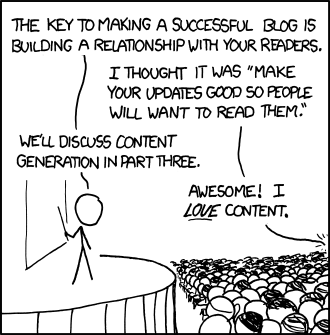
Also, this comic from the (brilliant) webcomic Xkcd sums everything up: