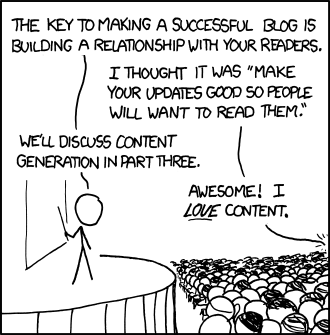
Before even trying to write the first words of this blog (which you are kindly reading and you deserve to be thanked - Thanks!) there was a drilling idea in my mind: how could a prospective blogger like myself create content that could be useful, readable and -why not- enjoyable for the web audience?
It's not as if there were few blogs: 179,632,592 blogs were detected by Blog Pulse as of the writing of this first entry. Several millions of them are inactive, but some aren't. In the last 24 hours, more than 1 million posts were produced (1,201,886 posts if you are very picky).
After a few (very much failed) attempts, I came up with a train of thoughts: there are a lot of journalist-like posts, therefore that would be a very bad idea, but conjunctural events are not only always in the climate of opinion, but they are always a somewhat clear reflection of what is happening in the world.
I have no idea how many blogs produce that type of content, and perhaps I don't really want to know. I can only know for sure what can make this a very enjoyable read: you will get your (daily? bi-daily? weekly?) post of whichever hot topic is in the news, with some analysis and always with an almost light hearted tone of voice; it's not that I don't think politics/economics/environment are not important, but I do think that if we can find more angles for reality, we will be able to understand it in a clearer fashion.
The very fact that I'm writing this (and hopefully, you are still reading) implies a democratization of communication of sorts. Yes, it is still true that larger media outlets still have a very large share of the impact to open audiences, but it is also true that several newspapers around the world have either stopped publishing their paper based media, or closed altoghether. But "blaming" the new media might be overestating its reach: the means for bloggers and Twitter addicts are modest to say the least compared to the huge "traditional" media industry. Two distinct conclusions can be taken from this: one, social/new media is not what will bring the final doom to traditional media and two, they might actually be complementary, bringing more in depth content in the "traditional" media, while allowing to reach immediatly to audiences through social media.
Where new media does excel for the "small people", (quoting BP's former CEO Tony Hayward's terrible PR gaffe) is allowing them to publish their thoughts, and showcase them to the public, avid for new and refreshing content.
This does not automatically mean that any content will be successful: all of us posting to the "blogosphere" (my eyes twitch whenever I hear that term) are exposed to total anonymity if their fail to catch any audience; they are also subject to the predators of the social media ecosystem, both real people (AKA trolls) or automated, porn or scam (or even weirder things) message replicators (AKA bots).
The real danger, though, comes from a more powerful thing: the “market” of information. The content in the internet, just as everything else, is subject to supply and demand. And the demand for content in the internet is so extreme that, given enough time to set up the tools, a user can possibly just read whatever they want to read. The challenge is to decide if taking up for a niche audience that will consume basically whatever you throw at them, or take a risk and take a more eclectic approach, producing different types of content.
What this blog be? We will have to wait to know further.
Anyway, thank you for visiting, and I look forward to add something significant to the discussion of world affairs.
Also, this comic from the (brilliant) webcomic Xkcd sums everything up: